The Empty Throne: The Myth at the Heart of a World
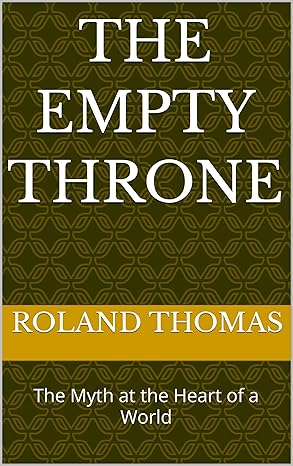
The Empty Throne is a mythic‑humanist exploration of how cultures create meaning, how stories shape identity, and how inherited myths can both illuminate and imprison the human spirit. At its centre is a simple but radical idea: the throne at the heart of every civilisation is empty —and always has been. Meaning is not bestowed from above; it is crafted, chosen, and continually renewed by human beings.
The book traces the evolution of myth from its earliest stirrings in pre‑narrative humanity to the complex religious and political systems that later claimed divine authority. It shows how myths that once helped people survive hardship gradually hardened into doctrines that sanctified suffering, suppressed individuality, and demanded obedience. Through this lens, Christian mythology becomes a case study in how stories can diminish the self by framing desire as temptation, agency as disobedience, and the body as an adversary.
Yet the book is not an attack on myth—it is a reclamation.
It argues that myth is not a chain but a tool, a mirror, a lantern for the long night. When we understand the old stories, we understand the forces that still shape us. When we unweave them, we reclaim the freedom to choose new ones.
Anna & Leo
★★★★★
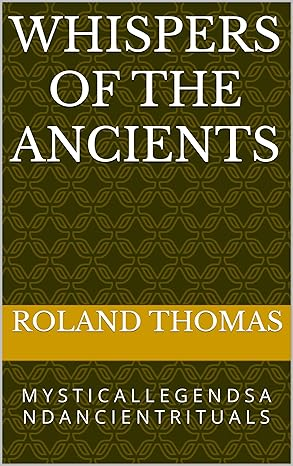
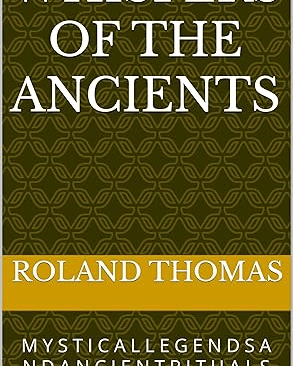
WHISPERS OF THE ANCIENTS: Mystical Legends and Ancient Ritual
This immersive volume journeys deep into the mythic heart of Celtic tradition, where stone circles hum with ancestral memory and spiral glyphs unlock forgotten truths. Roland Thomas guides readers through a tapestry of mystical legends, sacred rites, and symbolic landscapes—revealing the spiritual architecture of a culture shaped by nature, sovereignty, and seasonal rhythm.
From the horned god Cernunnos to the veiled wisdom of Brigid, the book explores deities, druids, and elemental forces that shaped the Celtic worldview. Each chapter unveils ancient rituals tied to the Wheel of the Year—Imbolc, Beltaine, Litha, Mabon, Samhain, and Yule—offering insight into the ceremonial practices that honored life, death, and rebirth.
Through poetic prose, historical depth, and ritual reconstruction, Whispers of the Ancients becomes both a scholarly guide and a spiritual companion. It invites readers to listen—to the stones, the trees, and the silence between chants—and to walk the misted path where myth becomes memory.
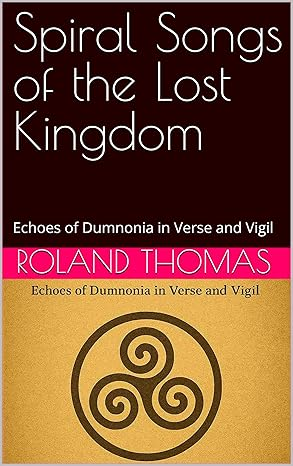
Spiral Songs of the Lost Kingdom: Echoes of Dumnonia in Verse and Vigil
This bardic collection is a ceremonial archive of verse, chant, and ancestral invocation—woven from the misted moorlands and mythic memory of Dumnonia. Through seasonal cycles, sigil-bound chants, and poetic offerings, the book reawakens the Hollow Throne and the voices that once guarded it.
Structured around the Celtic Wheel of the Year, each section offers responsive chants aligned with Imbolc, Beltaine, Litha, Mabon Tide, Samhain, and Yule. These verses serve not only as poetic expression but as ritual keys—activating sigils, summoning ancestral presence, and guiding the reader through thresholds of silence, sovereignty, and remembrance.
The work is both personal and communal: a vigil for the lost kingdom, a spiral song for those who walk the western path, and a living archive for future stewards of bardic tradition.
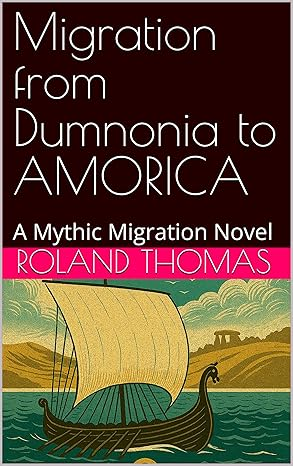
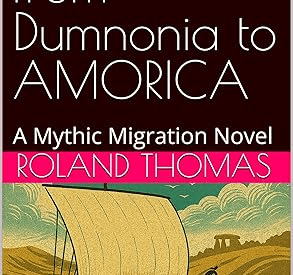
Migration from Dumnonia to AMORICA: A Mythic Migration Novel
In the twilight of Roman Britain, as the legions withdrew and the island fractured into warring kingdoms, the people of Dumnonia stood at a threshold. Their land—wild with moor and mist, rich with ancestral memory—was no longer safe from the encroaching tides of Saxon conquest and political dissolution. But Dumnonia was not merely a place. It was a rhythm, a resonance, a way of being.
Rather than vanish, they migrated.
Across the sea to Amorica—land of forests, granite, and kindred breath—they carried more than tools and kin. They carried the Archive: chants woven from moorland wind, sigils etched in stone and skin, rituals braided with memory. This was not a migration of survival alone. It was a mythic crossing—a ceremonial passage from one sacred ecology to another.
These novel traces that migration—not as mere history, but as mythic unfolding. It follows the footsteps of Ysella, Caerwyn, and Elen, stewards of the Archive, as they cross from dissolution to renewal, from moor to mist, from memory to becoming.
It is a tale of breath and bloom, of vanishing and return.
It is the story of how Dumnonia did not fall. It became Amorica.
Connect
Reach out to share your story or ask questions.
Call
+1-555-789-4321
© 2026. All rights reserved.